
Cable vs Glass vs Iron Railings: Which Is Best? (Bay Area Guide)
Three great railings, three different jobs
Cable, glass, and iron are the three railings East Bay homeowners ask about most, and none of them is “best” in the abstract — each wins for a different priority. Cable gives you a nearly invisible view with an industrial-modern edge. Glass gives you an unobstructed view plus a wind screen. Iron gives you timeless strength and, for period homes, historic accuracy. This guide compares them head to head on the things that actually decide the choice: look, cost, upkeep, how they hold up to salt air, and code. If you want a recommendation for your exact site, call (510) 390-9618 for a free on-site estimate.
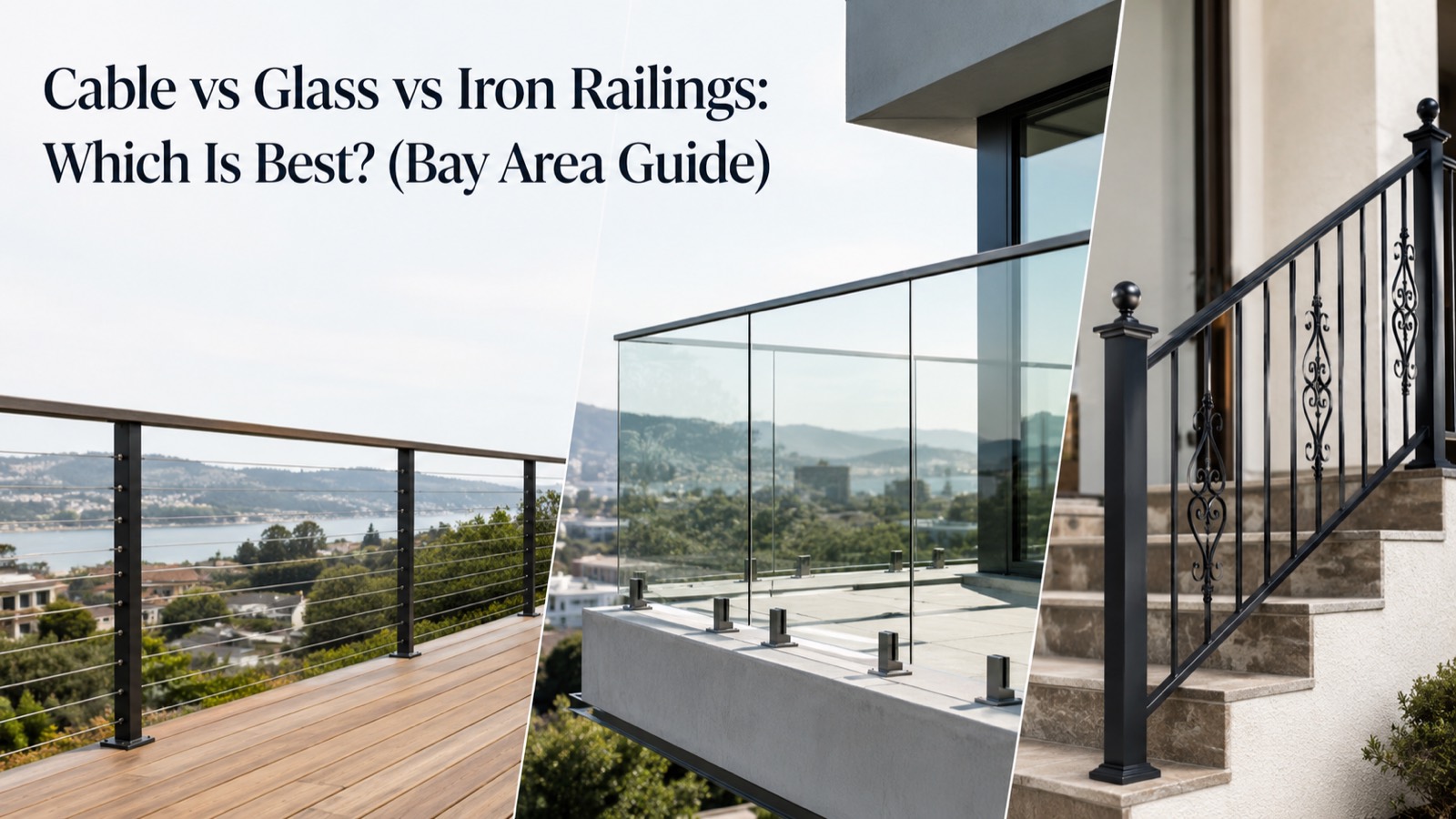
Side-by-side comparison
| Factor | Cable | Glass | Iron |
|---|---|---|---|
| Look | Minimal, modern, near-invisible | Frameless, open, contemporary | Classic, ornamental, traditional |
| Installed cost/ft | $75–$260 | $150–$600 | $65–$135 ($300–$900 hand-forged) |
| Maintenance | Occasional tension check & wipe-down | Frequent glass cleaning | Inspect finish; touch up before rust spreads |
| Coastal corrosion | Excellent in 316 stainless | Excellent; watch metal fittings | Needs powder coat/galvanizing to survive |
| View | Best — thin horizontal lines | Best — clear pane, blocks wind | Most visual obstruction |
| Best for | Decks, view lots, modern homes | Balconies, wind exposure, premium builds | Entries, stairs, Victorian/Edwardian homes |
Planning a concrete project in Alameda or the East Bay? Get a free, no-obligation on-site estimate and a written flat-rate price.
Cable railing
Cable railing uses thin horizontal runs of 1/8″–3/16″ stainless aircraft cable (1x19) tensioned between posts, so it almost disappears against a view. On the water it should be 316 marine-grade stainless, which shrugs off salt air. The tradeoffs: cable needs posts roughly every 4 feet to limit deflection, and to satisfy the 4-inch sphere rule the cables are spaced around 3 inches apart and kept properly tensioned — Oakland even publishes a cable-railing handout on exactly this challenge. Maintenance is light: check tension periodically and wipe the cables down. It is the go-to for deck and view lots and modern homes.
Glass railing
Glass railing — tempered or laminated panels held by standoffs, spigots, or a base shoe — gives you the most unobstructed view of the three and doubles as a wind screen, which matters on an exposed balcony. It reads clean and premium and is the top price tier ($150–$600/ft). The catch is upkeep: glass shows every fingerprint, water spot, and bit of salt spray, so it needs frequent cleaning to look its best, and the supporting metal hardware still has to be corrosion-rated for coastal sites. If an open, contemporary look and wind protection top your list, glass earns its premium.
Iron railing
Wrought and ornamental iron is the classic — strong, timeless, and endlessly customizable, from simple pickets to hand-forged scrollwork. For the East Bay’s enormous stock of Victorian, Edwardian, and Craftsman homes, iron is often the only period-correct choice, and Alameda’s historic homes fall under California Historical Building Code 8-504. The honest weakness is corrosion: bare or mild steel rusts quickly in salt air, so coastal iron must be properly prepped and powder-coated or hot-dip galvanized, then touched up before any rust gets a foothold. Done right, it lasts generations.
Code notes for all three
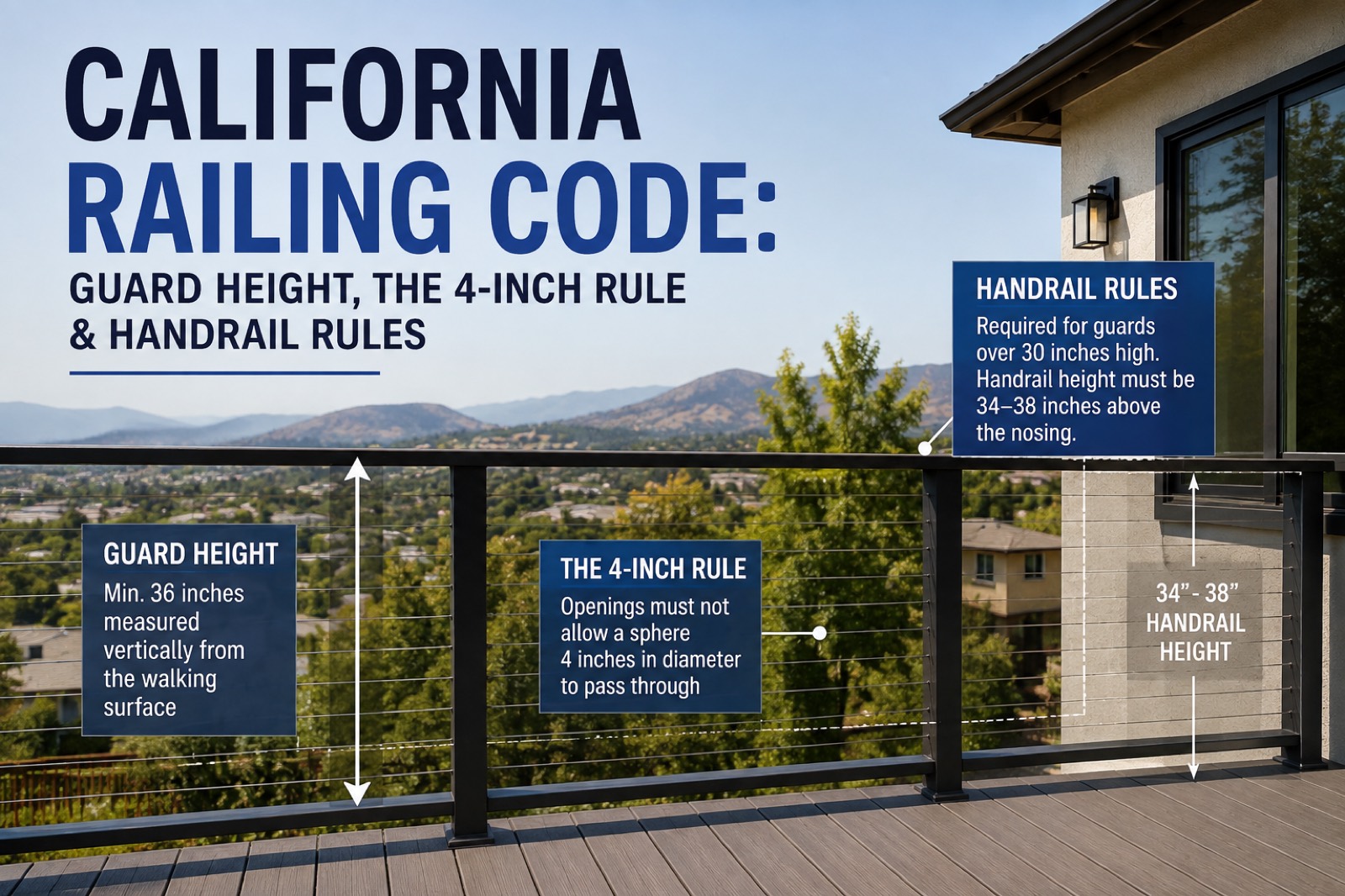
Whichever you choose, the same California code applies. A guard is required where the walking surface is more than 30 inches above grade, guard height is 42 inches (enforced across East Bay departments), and openings must not pass a 4-inch sphere — 6 inches at the stair-tread triangle. Cable systems meet the 4-inch rule through tight spacing and tension; glass meets it as a solid panel; iron meets it through baluster spacing. Guards must resist 20 lb per linear foot at the top rail. Always confirm specifics with your local department — see our code guide.
Maintenance is the other factor homeowners underrate. Cable asks the least of you — an occasional tension check and a wipe-down to keep the stainless bright. Glass asks the most attention to stay looking its best, because on the water it shows salt spotting quickly and wants regular cleaning; the payoff is that clear, open pane. Iron sits in between: its coating is what keeps it alive, so the maintenance is watchfulness — catch a chip or an early rust streak and touch it up before corrosion spreads under the finish. Match the material not just to the look you want but to the upkeep you will actually do.
Think about wind and exposure too. On an open Bay-facing balcony, glass earns its price by cutting the wind so the space is usable; cable and iron let the wind straight through. On a hillside deck with a view you paid for, cable or glass keeps that view; iron balusters interrupt it. And on a historic front entry, iron is often the only choice that looks right — a modern cable rail on a Victorian porch reads as a mismatch no matter how well it is built.
So which is best for you?
Choose cable for the cleanest view on a deck or modern home, glass for an unobstructed, wind-blocking balcony where budget allows, and iron for entries, stairs, and period homes that want strength and character. Many East Bay homes mix them — cable on the deck, iron at the historic front entry. We fabricate all three in-house and can show you samples on-site. One honest caveat worth repeating: whatever you pick, the coastal-grade version is the one to buy near the water — 316 stainless for cable, corrosion-rated hardware behind glass, and a proper powder-coat or galvanized finish on iron. The look is your call; the corrosion defense is not optional on the Bay.
Not sure which fits your home? We’ll walk your site and recommend the right system — free. Call (510) 390-9618.
Questions, Answered
Which railing has the best view?
Glass gives the most unobstructed view and blocks wind, while cable comes very close with thin, nearly invisible horizontal lines. Iron obstructs the most because of its balusters.
Which lasts longest near the water?
316 marine-grade stainless cable and properly powder-coated or galvanized iron both hold up well in salt air. Bare or mild steel is the one to avoid on the coast. See our coastal materials guide.
Which is cheapest?
Ornamental iron and aluminum are generally the most affordable per foot; glass sits at the premium end. Call (510) 390-9618 for a free estimate on your specific run.
Need Help in Alameda?
Alameda Custom Railing provides fast, same-day custom railing across Alameda, CA and the surrounding area — flat-rate pricing, licensed and insured, with 24/7 emergency service. Landed on this article from a search? Head back to our homepage to see everything we do, or reach out now.